March 6, 2026
Railway Costs $20+/mo. This Tool Costs $29 Once
Railway's usage-based billing adds up fast — most real apps cost $20-50/mo. We break down every charge and show how Server Compass lets you self-host the same stack on a $5 VPS.
TL;DR
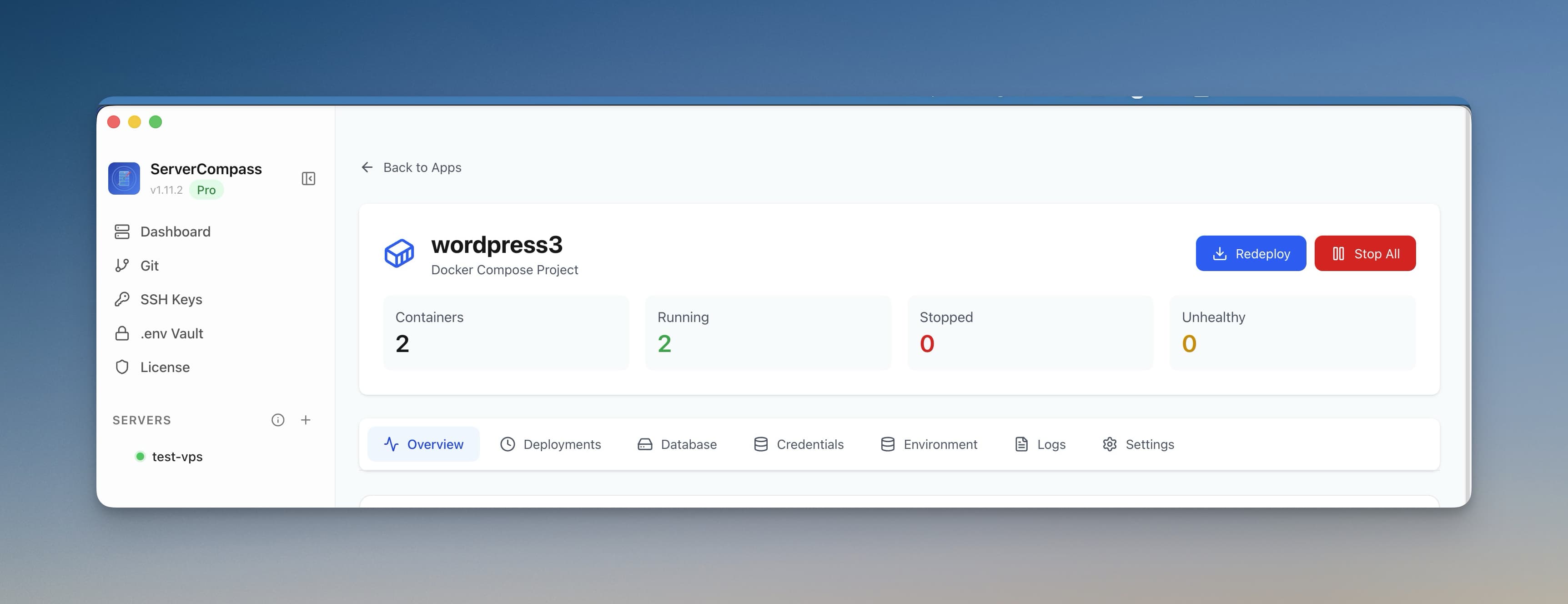
Most real apps on Railway cost $20–50+/mo with usage-based billing. Server Compass lets you self-host the same stack on a $5 VPS for a one-time $29 payment — predictable costs, no surprises.
Railway promises “pay for what you use” — but developers keep getting surprised by bills that are 2–5x what they expected. A Node.js app with a PostgreSQL database? That's $15–30/mo. Add Redis and a background worker? You're looking at $40–60/mo. The usage-based model makes it nearly impossible to predict your actual costs.
But here's what Railway's pricing calculator won't show you: how CPU and memory charges compound under real traffic, why egress fees catch teams off guard, and at what point a simple $5 VPS becomes the obvious alternative. We break down every charge below.
Pricing verified March 2026. Railway uses dynamic usage-based pricing — your costs will vary.
Railway Pricing Model Explained
Unlike platforms with fixed monthly plans, Railway charges based on actual resource consumption. This means your bill varies month to month depending on how much CPU, memory, network, and storage your applications use. Let's break down each component.
The Credit-Based System
Railway operates on a credit system where $1 equals 1 credit. Your account accumulates charges throughout the month based on resource usage, and you're billed at the end of the billing cycle. This approach means you never pay upfront for resources you might not use — but it also means unpredictable bills if you're not careful.
Free Tier ($5 Credit)
Railway offers a trial tier that includes $5 of free usage. This sounds generous, but let's put it in perspective:
- Execution hours: Approximately 500 hours of a basic service (assuming minimal CPU and ~256MB RAM)
- What that means: A single always-on service runs 720+ hours per month, so you'll exceed the free tier quickly
- Verification required: You need to verify your account (credit card or GitHub account with history) to access the trial
- No databases on trial: The free tier has limited database provisioning
The trial is best for testing Railway or running occasional one-off tasks — not for hosting production applications.
Hobby Plan ($5/month)
The Hobby plan costs $5 per month and includes:
- $5 of resource usage included
- Access to all Railway features
- Unlimited services
- Community support
Important: The $5 is a credit toward usage, not a flat fee. If you use more than $5 worth of resources, you pay the difference. If you use less, you don't get a refund — it's use-it-or-lose-it.
Pro Plan ($20/month per seat)
The Pro plan costs $20 per month per team member and includes:
- $20 of resource usage included per seat
- Higher resource limits
- Team collaboration features
- Priority support
- Advanced metrics and observability
Again, the $20 is credit toward usage. A team of 3 on the Pro plan pays $60/month minimum, with $60 in usage credit. Exceed that, and you pay overage.
What Costs Money on Railway
Understanding Railway's pricing requires knowing exactly what gets metered. Here's the complete breakdown of billable resources as of 2026.
CPU Usage
Resource
Price
Calculation
vCPU
$0.000463 per vCPU minute
~$0.028/hour, ~$20/month for 1 vCPU 24/7
CPU is charged per vCPU-minute. If your application uses 0.5 vCPU on average, you pay half the rate. The challenge is that CPU usage can spike unpredictably — a traffic surge or a heavy background job can suddenly increase your bill.
Example calculation: An app using 0.25 vCPU continuously for a month:
0.25 vCPU × 43,200 minutes × $0.000463 = $5.00/month
Memory Usage
Resource
Price
Calculation
RAM
$0.000231 per GB minute
~$0.014/hour per GB, ~$10/month for 1GB 24/7
Memory is charged per GB-minute. Unlike CPU which can fluctuate, memory usage tends to be more stable — but also more predictable to calculate.
Example calculation: A Node.js app using 512MB RAM continuously:
0.5 GB × 43,200 minutes × $0.000231 = $4.99/month
Network Egress
Resource
Price
Notes
Outbound traffic
$0.10 per GB
First 100GB included on Pro plan
Network egress — data leaving Railway to the internet — costs $0.10 per GB. This includes:
- API responses sent to clients
- Images and files served by your app
- Database query results (if accessed externally)
- Webhook payloads
Internal traffic between Railway services is free, which is a significant advantage for microservice architectures.
Example: A medium-traffic API serving 50GB of responses per month:
50 GB × $0.10 = $5.00/month
Persistent Storage
Resource
Price
Notes
Volume storage
$0.25 per GB month
SSD-backed persistent volumes
Persistent volumes for databases and file storage cost $0.25 per GB per month. This is relatively affordable, but it adds up for data-heavy applications.
Example: A PostgreSQL database with 20GB of data:
20 GB × $0.25 = $5.00/month
Real-World Cost Examples
Now let's calculate what you'll actually pay for common Railway deployments. These examples use realistic resource consumption based on typical applications.
Example 1: Simple Node.js/Express API
A basic Express API handling 10,000 requests per day with low complexity:
Resource
Usage
Monthly Cost
CPU
0.1 vCPU average
$2.00
Memory
256MB constant
$2.49
Network
5GB egress
$0.50
Total
$4.99/month
A simple API fits within the Hobby plan's $5 credit. But this is a minimal app with low traffic. Scale it up, and costs rise quickly.
Example 2: PostgreSQL Database
A managed PostgreSQL database for a typical SaaS application:
Resource
Usage
Monthly Cost
CPU
0.25 vCPU average
$5.00
Memory
1GB constant
$9.98
Storage
10GB
$2.50
Total
$17.48/month
A PostgreSQL database alone costs nearly $18/month — exceeding the Hobby plan's included credit by almost 3.5x. This is where Railway's pricing becomes less competitive compared to self-hosted alternatives.
Example 3: Full-Stack App with Database
A Next.js application with PostgreSQL and Redis — a common production stack:
Service
CPU
Memory
Storage
Network
Cost
Next.js App
0.25 vCPU
512MB
-
20GB
$11.99
PostgreSQL
0.25 vCPU
1GB
15GB
-
$18.73
Redis
0.1 vCPU
256MB
1GB
-
$4.74
Total
$35.46/month
A typical full-stack application costs around $35-40/month on Railway. Add more services, handle more traffic, or store more data, and you're quickly looking at $50-100+/month.
Example 4: High-Traffic Production App
A SaaS application with 100,000 daily active users:
Service
Resources
Monthly Cost
API Server (2 instances)
0.5 vCPU, 1GB RAM each
$39.92
PostgreSQL
0.5 vCPU, 2GB RAM, 50GB storage
$42.46
Redis
0.25 vCPU, 512MB RAM
$9.99
Background Worker
0.5 vCPU, 1GB RAM
$19.96
Network Egress
200GB
$20.00
Total
$132.33/month
At scale, Railway costs can exceed $130/month — and this is still a modest production workload. High-growth startups often see Railway bills reach $300-500+/month.
Railway vs VPS Cost Comparison
How does Railway compare to running the same workloads on a VPS? Let's compare side-by-side for the full-stack example above.
Platform
Configuration
Monthly Cost
Railway
Next.js + PostgreSQL + Redis
$35-40
Hetzner VPS
CX21 (2 vCPU, 4GB RAM, 40GB SSD)
$4.85
DigitalOcean
Basic Droplet (2 vCPU, 4GB RAM, 80GB SSD)
$24.00
Vultr
Cloud Compute (2 vCPU, 4GB RAM, 80GB SSD)
$24.00
A single VPS can run all three services (Next.js, PostgreSQL, Redis) with room to spare. The cost difference is dramatic:
- Railway: $35-40/month (usage-based, can fluctuate)
- Hetzner VPS: $4.85/month (fixed, predictable)
- Annual savings: $360-420 by self-hosting
For the high-traffic example, the difference is even more stark:
- Railway: $132/month
- Hetzner VPS (CPX31): $14.76/month (4 vCPU, 8GB RAM, 160GB)
- Annual savings: $1,406 by self-hosting
When Railway Makes Sense
Despite the cost difference, Railway can be the right choice in certain scenarios:
Railway is a Good Fit When:
- You're prototyping or building MVPs — The speed of deployment justifies the cost for short-term projects
- You have variable workloads — If your app runs intensively for a few hours, then sits idle, usage-based pricing can work in your favor
- You need instant scaling — Railway handles scaling automatically; no manual intervention needed
- Your team lacks DevOps experience — Zero infrastructure management means developers focus purely on code
- You're spending under $20/month — For very small apps, the convenience may be worth the premium
When to Switch to VPS
Self-hosting becomes the smarter choice as your application grows. Consider switching when:
A VPS is Better When:
- Your Railway bill exceeds $30-50/month — At this point, a VPS provides better value
- You need predictable costs — VPS pricing is fixed; no surprise bills from traffic spikes
- You're running databases — Managed databases on Railway are expensive; self-hosted databases cost only the disk space
- You need more control — Custom configurations, specific software versions, or specialized setups
- You're running multiple projects — A single VPS can host 5-10 applications for the price of one on Railway
- You want to own your infrastructure — No vendor lock-in, full data ownership
For a deeper comparison, see our Railway vs Server Compass comparison.
Alternative: Predictable Costs with Server Compass
If Railway's usage-based pricing doesn't fit your budget, self-hosting on your own VPS offers a compelling alternative. But you don't have to sacrifice developer experience to get predictable costs.
Server Compass gives you the deployment simplicity of Railway while running on your own VPS:
- One-click deployments — Connect your GitHub repo and deploy with a click, just like Railway
- 100+ templates — Deploy PostgreSQL, Redis, MongoDB, and more from the template library
- Automatic SSL — Let's Encrypt certificates provisioned automatically
- GitHub Actions CI/CD — Zero-downtime deployments via automated pipelines
- Framework detection — Auto-detect 16+ frameworks including Node.js, Python, Go, and more
- Fixed pricing — $29 one-time license + your VPS cost (starting at $5/month)
Cost Comparison Summary
Stack
Railway
Server Compass + Hetzner
Annual Savings
Simple API
$5-10/month
$4.85/month
$0-60
Full-stack + DB
$35-40/month
$4.85/month
$360-420
Production SaaS
$100-150/month
$10-20/month
$960-1,560
See our complete Railway alternative guide for more details on migrating from Railway to self-hosted infrastructure.
Hidden Costs and Gotchas
Before committing to Railway, be aware of these less-obvious cost factors:
Build Minutes
Railway charges for build time at the same rate as runtime. A complex build that takes 5-10 minutes can cost $0.50-1.00 per deployment. Deploy 10 times a day during active development, and that's an extra $150-300/month.
Preview Environments
Railway's preview deployments are convenient but cost real money. Each PR creates a new environment with its own resources. Active development with multiple PRs can significantly increase costs.
Database Backups
Point-in-time recovery and backups consume storage, which is charged at $0.25/GB/month. A database with 30 days of backups can cost 2-3x the base storage cost.
Idle Services
Unlike some platforms, Railway charges for idle services. An always-on service that handles minimal traffic still incurs CPU and memory charges 24/7.
Frequently Asked Questions
Is Railway really free?
Railway offers a trial tier with $5 of free usage, but this is very limited. A single always-on service with a database will exceed this within the first week. The trial is best for testing, not production use.
Is Railway cheaper than Vercel?
It depends on your workload. Railway can be cheaper for applications that need databases, WebSockets, or background workers — things Vercel doesn't handle well. But for simple frontend deployments, Vercel's free tier is more generous.
How can I predict my Railway costs?
Railway provides a usage dashboard showing real-time costs. For estimates, use this formula:
Monthly Cost = (vCPU hours × $0.028) + (GB-hours RAM × $0.014) + (GB egress × $0.10) + (GB storage × $0.25)
Monitor your first week of usage, then multiply by 4 for a monthly estimate.
Can I set cost limits on Railway?
Railway allows you to set usage limits and alerts, but these are soft limits — your services may be stopped if you exceed them, potentially causing downtime. There's no hard spending cap that keeps services running while preventing overages.
Why are databases so expensive on Railway?
Railway databases run as full services with dedicated CPU, memory, and storage — all billed separately. A modest PostgreSQL instance easily costs $15-20/month, whereas the same database on a VPS uses existing resources at no additional cost.
How do I migrate from Railway to a VPS?
Migration involves:
- Setting up a VPS with Docker
- Exporting your database from Railway
- Deploying your application containers to the VPS
- Updating DNS to point to your VPS
Tools like Server Compass simplify this process with one-click database deployments and GitHub integration. See our Railway alternative guide for detailed migration steps.
Is Railway worth it?
Railway is worth it for small projects, prototypes, and teams that prioritize developer experience over cost optimization. Once your bill exceeds $30-50/month consistently, self-hosting becomes more economical while still providing a great developer experience with the right tools.
Conclusion
Railway's usage-based pricing offers flexibility but can lead to unpredictable and often higher costs than alternatives. For simple applications under $20/month, Railway provides excellent value through its developer experience. But as your application grows, the cost-per-resource quickly exceeds what you'd pay for equivalent VPS infrastructure.
The key takeaways for understanding Railway pricing:
- CPU costs ~$20/month per full vCPU; memory costs ~$10/month per GB
- Databases are expensive: expect $15-25/month minimum for PostgreSQL
- Full-stack applications typically cost $35-50/month on Railway
- The same workload costs $5-15/month on a self-managed VPS
- Annual savings of $360-1,500+ are possible by self-hosting
If you're looking for Railway's deployment simplicity without the usage-based pricing surprises, consider Server Compass. Get one-click deployments, managed databases, and automatic SSL — all on your own VPS for a fixed monthly cost.
Related resources:
- Railway Alternative: Self-Host with Server Compass
- Railway vs Server Compass: Detailed Comparison
- Why Self-Hosting Is the Smartest Move for Developers
- Deploy PostgreSQL on Your VPS
Related in the StoicSoft network
If you're self-hosting on a VPS or working through a deployment guide like the one above, DeployToVPS is the StoicSoft network's handbook for VPS deployment recipes — docker-compose, nginx, traefik, and common app self-hosts.
From across the StoicSoft network
Hand-curated reads on the same topic from sister sites in the StoicSoft family.
 1DevTool11 min read
Self-Hosted AI Coding Assistant Workflow: Practical Setup Guide
A self-hosted AI coding workflow needs more than model hosting. You need environment control, connector governance, and reproducible operations. This guide covers the practical stack.
Read on 1devtool.com 1DevTool10 min read
One-Time Purchase Code Editor Alternatives in 2026
Subscription fatigue is real for individual developers and small teams. Here is a framework for evaluating one-time purchase code editor alternatives without sacrificing AI workflows.
Read on 1devtool.com