Environment Variables Editor
Intuitive UI for managing secrets and environment variables. Add, edit, and revoke variables without touching config files.
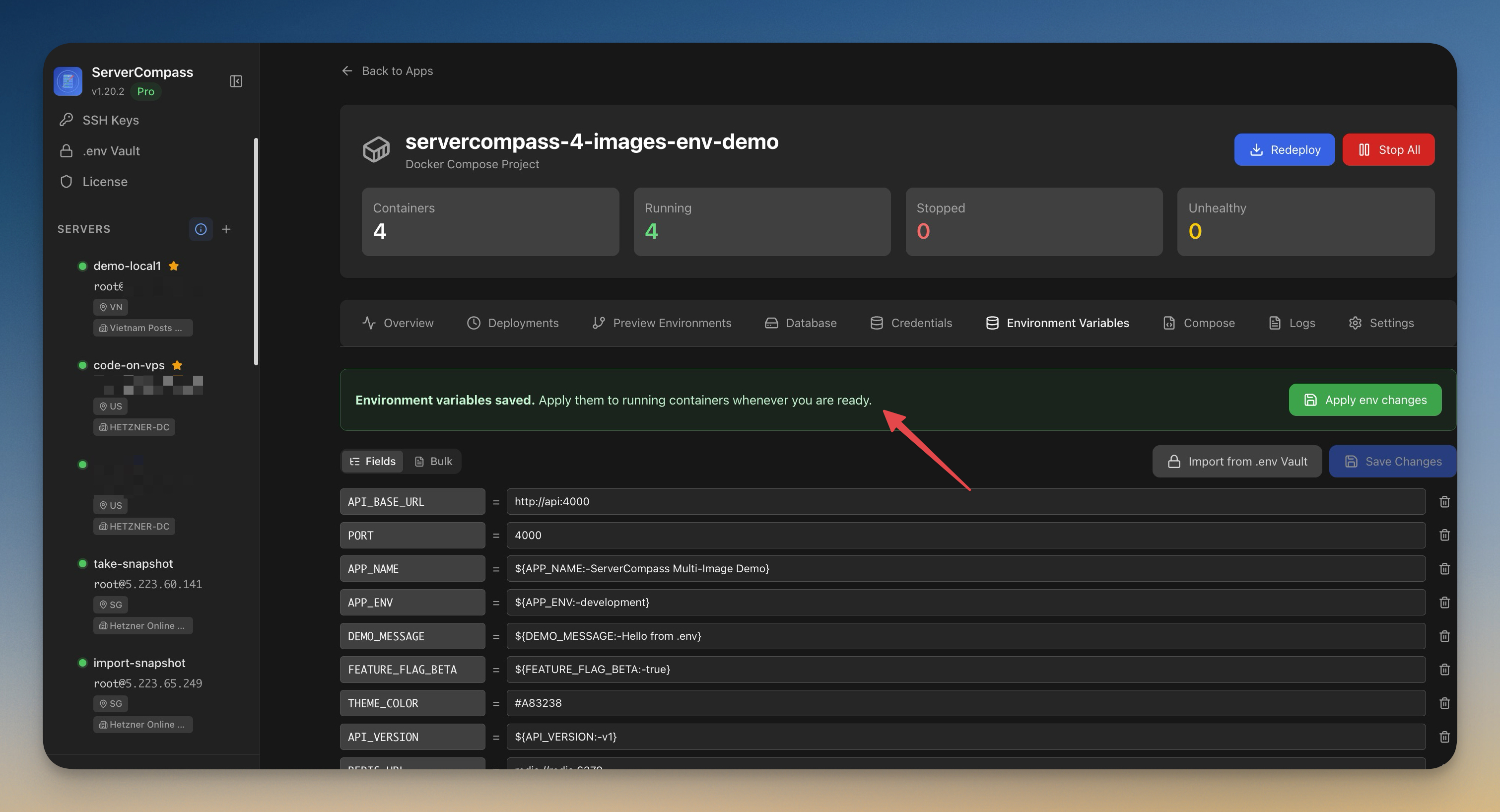
Using Environment Variables Editor in Server Compass
Using Environment Variables Editor is straightforward. Follow these simple steps to get started.
Open Deployment Panel
Navigate to the Environment Variables Editor section in your Server Compass dashboard.
Configure Settings
Fill in the required configuration through the visual interface.
Deploy
Review your settings and deploy with a single click.
What If You Don't Have Environment Variables Editor?
Before Environment Variables Editor, this is what server management looked like. Spoiler: it wasn't fun.
SSH into your server
First, open your terminal and connect to your VPS.
ssh root@your-server-ipClone your repository
Navigate to your apps directory and clone the repo.
cd /opt/apps
git clone https://github.com/your-username/your-repo.git
cd your-repoCreate environment file
Manually create and configure your .env file.
nano .env
# Add all your environment variables one by one
# DATABASE_URL=...
# API_KEY=...
# SECRET_KEY=...
One wrong character and your app won't start. No validation, no hints.
Build the Docker image
Build your application image from the Dockerfile.
docker build -t myapp:latest .
# Wait 5-15 minutes...
# Hope there are no build errors...Write docker-compose.yml
Manually write your compose configuration.
nano docker-compose.yml
# services:
#   app:
#     image: myapp:latest
#     ports:
#       - "3000:3000"
#     environment:
#       - NODE_ENV=production
# restart: unless-stoppedDeploy the container
Start the container and pray it works.
docker compose up -d
docker compose logs -f
# Ctrl+C when you're tired of watching logsOne Click > 50 Commands
Environment Variables Editor in Server Compass does all of this with a single click. No terminal. No memorizing commands. No 3 AM debugging sessions.
- No SSH required
- Guided workflows
- Undo support
- Multi-server management
Everything Environment Variables Editor Offers
Everything you need for deployment in one integrated tool, replacing complex CLI commands and manual configuration.
Get StartedBenefits of Environment Variables Editor
Server management shouldn't require a DevOps team. Environment Variables Editor makes professional-grade deployment accessible to everyone.
Deploy in Minutes
Environment Variables Editor eliminates complex CLI workflows. Deploy your applications visually without memorizing Docker commands.
Zero-Configuration Defaults
Environment Variables Editor comes pre-configured with production-ready settings so you can ship with confidence.
Visual Feedback
Track every step of your deployment with Environment Variables Editor. See progress, logs, and status in real time.
Repeatable Process
Once configured, Environment Variables Editor lets you replicate deployments across servers consistently.
Environment Variables Editor FAQ
Common questions about Environment Variables Editor in Server Compass
How do I access Environment Variables Editor in Server Compass?
Environment Variables Editor is available in the Deployment section of Server Compass. Simply connect to your server, navigate to Deployment, and you'll find Environment Variables Editor ready to use. No additional setup or plugins required.
Does Environment Variables Editor require any server-side installation?
No. Server Compass operates as a desktop application that connects to your server via SSH. Environment Variables Editor works through this connection without installing any agents or packages on your server (except the optional monitoring agent for resource tracking).
Is Environment Variables Editor included in all Server Compass plans?
Yes. Every Server Compass feature, including Environment Variables Editor, is included with the one-time $29 payment. There are no tier restrictions, add-ons, or per-server fees. You get all 152+ features for all your servers.
Can I use Environment Variables Editor with any VPS provider?
Environment Variables Editor works with any VPS or dedicated server that supports SSH access and Docker. This includes DigitalOcean, Hetzner, Vultr, Linode, AWS EC2, Google Cloud, Azure, and any other provider. It also works with local servers and homelab setups.
What makes Environment Variables Editor different from command-line alternatives?
Environment Variables Editor provides a visual, intuitive interface that replaces complex CLI commands and configuration files. You get real-time feedback, safety confirmations, and a consistent experience across all your servers without memorizing syntax or writing scripts.
More Deployment Features
Explore other deployment capabilities in Server Compass
Docker Stack Wizard
Multi-step wizard walks you through deploying containerized applications. Choose source, configure settings, and deploy in minutes.
Template-Based Deployment
Choose from 100+ pre-built templates for databases, services, and development tools. Deploy popular stacks with one click.
Deploy from GitHub
Deploy directly from any GitHub repository. Select branches, configure build settings, and ship your code to production.
Docker Compose Editor
Full-featured YAML editor for docker-compose configurations. Write, edit, and validate your compose files visually.
Try Environment Variables Editor Today
Download Server Compass and get access to Environment Variables Editor along with 151 other features. One-time $29 payment. No subscriptions. No per-server fees.