Cloudflare Tunnel
Publish one app to the internet at a real hostname through a dedicated, outbound-only Cloudflare Tunnel. No firewall port is opened, ports 80/443 stay free, and your existing reverse proxy is untouched — traffic reaches your container by leaving the server, so your origin IP never appears in public DNS.
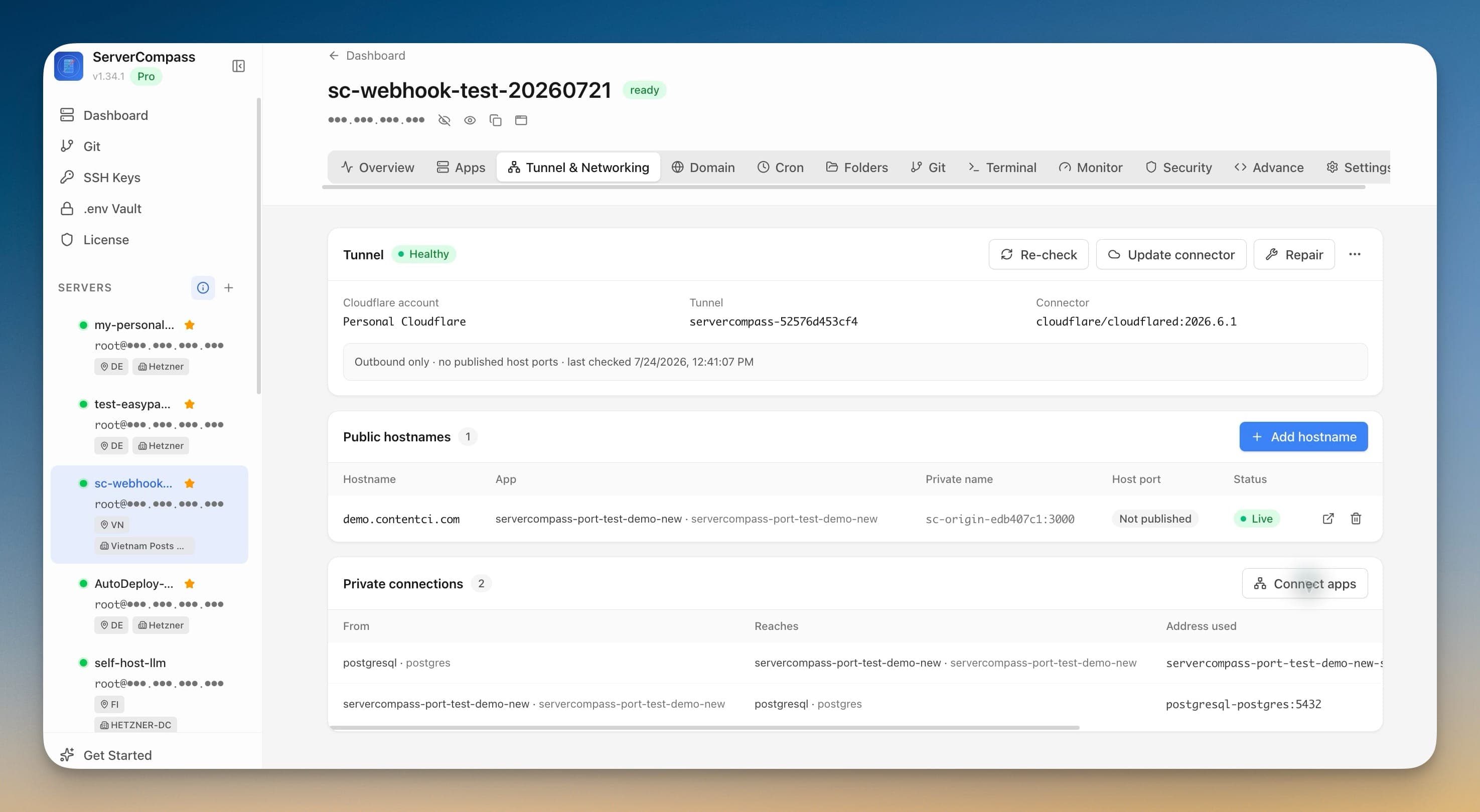
How Cloudflare Tunnel Works
No documentation needed. Cloudflare Tunnel guides you through each step visually.
Open Domain Settings
Navigate to the Domains & SSL section of your application.
Configure Domain
Use Cloudflare Tunnel to set up your domain configuration.
Verify & Apply
Server Compass verifies your settings and applies changes automatically.
The Terminal Way: No Cloudflare Tunnel
Without Cloudflare Tunnel, you're back to the dark ages of server management. Here's what that looks like.
SSH into your server
Connect to configure domains.
ssh root@your-server-ipInstall Certbot
Set up Let's Encrypt tooling.
apt update
apt install certbot python3-certbot-nginx
# Or for standalone:
apt install certbotConfigure nginx
Set up reverse proxy manually.
nano /etc/nginx/sites-available/myapp
# server {
#     listen 80;
#     server_name myapp.com www.myapp.com;
#     location / {
#         proxy_pass http://localhost:3000;
#         proxy_http_version 1.1;
#         proxy_set_header Upgrade $http_upgrade;
#         proxy_set_header Connection 'upgrade';
#         proxy_set_header Host $host;
#         proxy_cache_bypass $http_upgrade;
#     }
# }

ln -s /etc/nginx/sites-available/myapp /etc/nginx/sites-enabled/
nginx -t
systemctl reload nginx
One syntax error = site down.
Generate SSL certificate
Run Certbot and cross your fingers.
certbot --nginx -d myapp.com -d www.myapp.com
# Answer the interactive prompts
# Wait for DNS verification
# Hope it doesn't failSet up auto-renewal
Don't forget or your cert expires.
# Test renewal
certbot renew --dry-run

# Add cron job
crontab -e
# 0 12 * * * /usr/bin/certbot renew --quiet
Forget this step and your site shows security warnings in 90 days.
Your Time is Worth More
Cloudflare Tunnel in Server Compass does all of this with a single click. No terminal. No memorizing commands. No 3 AM debugging sessions.
- One-click actions
- Real-time feedback
- Automatic backups
- Zero CLI knowledge required
Cloudflare Tunnel Features
Everything you need for domains & ssl in one integrated tool, replacing complex CLI commands and manual configuration.
Get StartedThe Power of Cloudflare Tunnel
Server management shouldn't require a DevOps team. Cloudflare Tunnel makes professional-grade domains & ssl accessible to everyone.
Automatic HTTPS
Cloudflare Tunnel handles SSL certificate provisioning and renewal automatically via Let's Encrypt.
Instant Propagation
Cloudflare Tunnel verifies DNS settings and configures routing instantly once records are pointing correctly.
Certificate Monitoring
Cloudflare Tunnel tracks certificate expiry and health so you never face an unexpected SSL error.
Zero Downtime Changes
Cloudflare Tunnel applies domain configuration changes without interrupting live traffic.
Cloudflare Tunnel: Frequently Asked
Common questions about Cloudflare Tunnel in Server Compass
How do I access Cloudflare Tunnel in Server Compass?
Cloudflare Tunnel is available in the Domains & SSL section of Server Compass. Simply connect to your server, navigate to Domains & SSL, and you'll find Cloudflare Tunnel ready to use. No additional setup or plugins required.
Does Cloudflare Tunnel require any server-side installation?
No. Server Compass operates as a desktop application that connects to your server via SSH. Cloudflare Tunnel works through this connection without installing any agents or packages on your server (except the optional monitoring agent for resource tracking).
Is Cloudflare Tunnel included in all Server Compass plans?
Yes. Every Server Compass feature, including Cloudflare Tunnel, is included with the one-time $29 payment. There are no tier restrictions, add-ons, or per-server fees. You get all 152+ features for all your servers.
Can I use Cloudflare Tunnel with any VPS provider?
Cloudflare Tunnel works with any VPS or dedicated server that supports SSH access and Docker. This includes DigitalOcean, Hetzner, Vultr, Linode, AWS EC2, Google Cloud, Azure, and any other provider. It also works with local servers and homelab setups.
What makes Cloudflare Tunnel different from command-line alternatives?
Cloudflare Tunnel provides a visual, intuitive interface that replaces complex CLI commands and configuration files. You get real-time feedback, safety confirmations, and a consistent experience across all your servers without memorizing syntax or writing scripts.
More Domains & SSL Features
Explore other domains & ssl capabilities in Server Compass
Visual Domain Management
Add and configure domains with an intuitive UI. Built-in Traefik reverse proxy handles routing and load balancing.
Automatic SSL Certificates
Free SSL certificates from Let's Encrypt with automatic renewal. HTTPS for all your domains with zero configuration.
DNS Verification
Automatic DNS verification checks ensure your domain is correctly pointed before configuring SSL and routing.
Certificate Viewer
View detailed SSL certificate information including issuer, expiry, and chain. Renew certificates with one click.
Try Cloudflare Tunnel Today
Download Server Compass and get access to Cloudflare Tunnel along with 151 other features. One-time $29 payment. No subscriptions. No per-server fees.