Offload Apps
Free disk space from apps you rarely use by removing their containers and images while keeping their data, settings, domains and tunnel routes. Reinstall brings an app back at the exact image versions it ran.
How Offload Apps Works
Using Offload Apps is straightforward. Follow these simple steps to get started.
Open Offload App
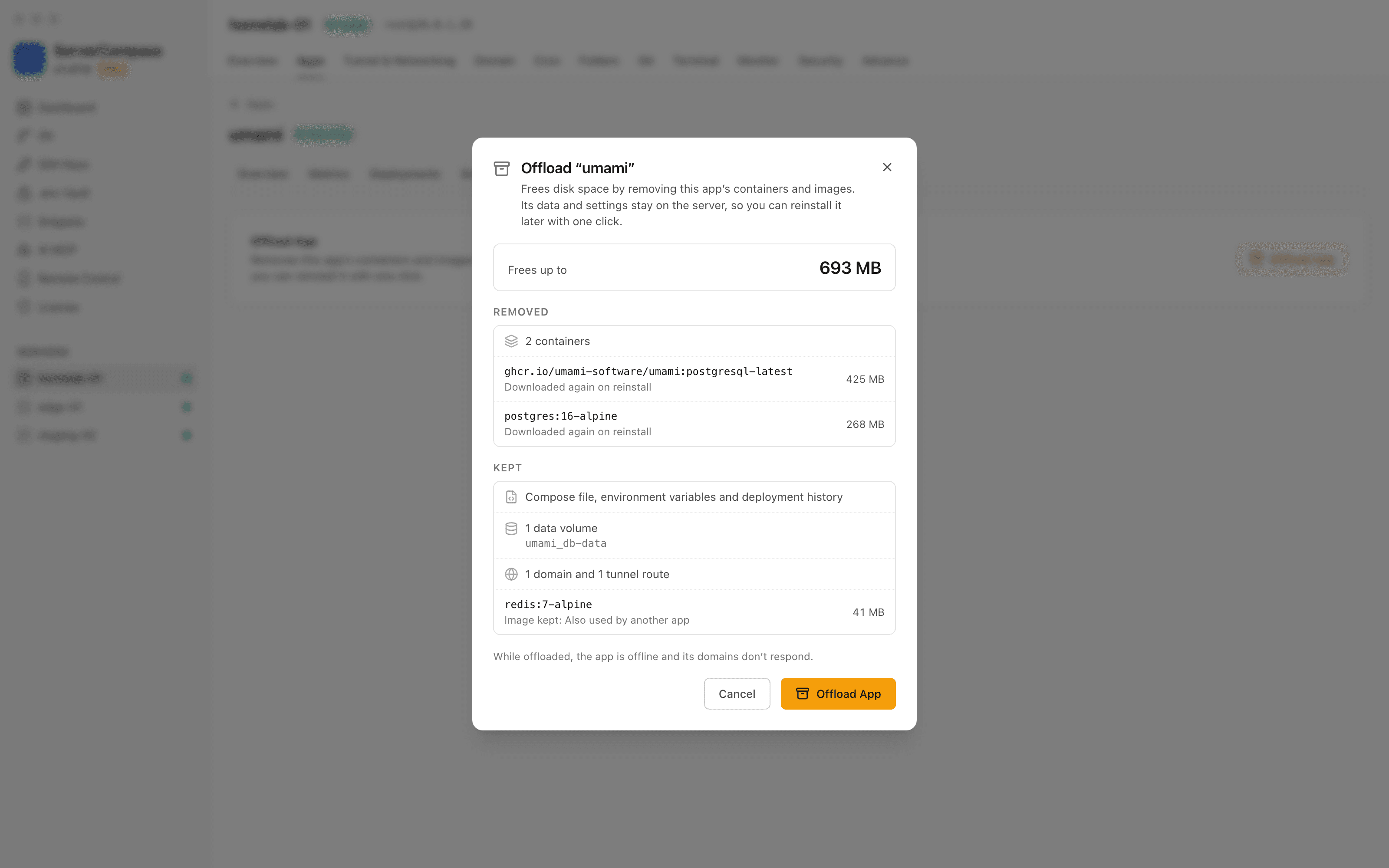
Choose Offload App in the app’s Settings tab, or follow the “Rarely used? Offload to free up to …” suggestion in its Disk Usage panel.
Read the plan before anything is removed
The dialog checks the server and shows Frees up to, each container and image that goes with how it comes back, and everything kept: compose file, environment, history, data volumes, domains and tunnel routes.
Confirm what won’t come back
Images another app uses or that can’t be downloaded again are kept. Folders on anonymous volumes are listed under Some data won’t come back and need a tick before Offload App runs.
Reinstall when you need it
The app shows This app is offloaded with a Reinstall button, and the Apps list offers Reinstall in place of Start. Images are rebuilt from source or downloaded by exact digest, then the app starts on its existing data.
What If You Don't Have Offload Apps?
Before Offload Apps, this is what server management looked like. Spoiler: it wasn't fun.
Record the exact image versions
Before removing anything, save each image’s ID and digest so the same version can come back.
cd /opt/apps/analytics
docker compose images
docker compose images -q | sort -u > images.txt
xargs docker image inspect --format '{{.RepoTags}} {{.RepoDigests}}' < images.txt
An image built on the server has no digest. Without its source it can’t come back.
Remove the containers, not the data
Take the containers down while the named volumes stay on disk. Its domains now point at nothing.
docker compose down
# not: docker compose down -v
One extra -v deletes the app’s named volumes and its data with them.
Remove only the images nothing else needs
Check what other containers still run on, then delete the app’s images.
docker ps -a --format '{{.Image}}' | sort -u
xargs docker image rm < images.txt
Remove an image that only exists on this server and the app can’t come back without rebuilding it.
Bring it back by digest
Pull each image by the digest you saved, tag it back to the name in the compose file, then start the stack.
docker pull ghcr.io/owner/app@sha256:<digest>
docker tag ghcr.io/owner/app@sha256:<digest> ghcr.io/owner/app:1.4
docker compose up -d
Until then the data volumes have no container, so a later docker volume prune -a deletes them with everything else unused.
One Click > 50 Commands
Stop copy-pasting commands from Stack Overflow. Offload Apps gives you a proper interface for server management.
- No SSH required
- Guided workflows
- Undo support
- Multi-server management
Offload Apps Features
Everything you need for app management in one integrated tool, replacing complex CLI commands and manual configuration.
Get StartedBenefits of Offload Apps
Server management shouldn't require a DevOps team. Offload Apps makes professional-grade app management accessible to everyone.
Complete Visibility
Offload Apps gives you a bird's-eye view of all your applications. No more guessing container states.
Instant Actions
Offload Apps puts start, stop, restart, and rollback at your fingertips with one-click controls.
Safe Operations
Offload Apps includes safety guards and confirmations to prevent accidental destructive actions.
Historical Context
Offload Apps keeps a full audit trail so you always know what changed and when.
Offload Apps FAQ
Common questions about Offload Apps in Server Compass
How do I access Offload Apps in Server Compass?
Offload Apps is available in the App Management section of Server Compass. Simply connect to your server, navigate to App Management, and you'll find Offload Apps ready to use. No additional setup or plugins required.
Does Offload Apps require any server-side installation?
No. Server Compass operates as a desktop application that connects to your server via SSH. Offload Apps works through this connection without installing any agents or packages on your server (except the optional monitoring agent for resource tracking).
Is Offload Apps included in all Server Compass plans?
Yes. Every Server Compass feature, including Offload Apps, is included with the one-time $29 payment. There are no tier restrictions, add-ons, or per-server fees. You get all 157+ features for all your servers.
Can I use Offload Apps with any VPS provider?
Offload Apps works with any VPS or dedicated server that supports SSH access and Docker. This includes DigitalOcean, Hetzner, Vultr, Linode, AWS EC2, Google Cloud, Azure, and any other provider. It also works with local servers and homelab setups.
What makes Offload Apps different from command-line alternatives?
Offload Apps provides a visual, intuitive interface that replaces complex CLI commands and configuration files. You get real-time feedback, safety confirmations, and a consistent experience across all your servers without memorizing syntax or writing scripts.
More App Management Features
Explore other app management capabilities in Server Compass
Application Dashboard
View all deployed applications with real-time status indicators. Switch between grid and table view for your preferred workflow.
Grid & Table View
Toggle between visual grid cards and compact table view. See container status, uptime, and quick actions at a glance.
Container Health Monitoring
Real-time container status with uptime tracking, health check indicators, and resource usage per container.
Zero-Downtime Deployment
Blue-green deployment keeps the old container serving while the new one is built and health-checked, then switches traffic over. Progress appears the moment you press Redeploy, the deployment is recorded in history right away with its commit, and a deploy that passes 45 minutes stops with a message pointing you at the logs.
Try Offload Apps Today
Download Server Compass and get access to Offload Apps along with 156 other features. One-time $29 payment. No subscriptions. No per-server fees.