April 5, 2026
20 Best Self-Hosted Apps You Can Run on a VPS
The definitive self-hosted software list for 2026. From n8n and Plausible Analytics to Supabase and Nextcloud, here are 20 apps worth running on your own server with one-click deploys.
Every year the list of awesome self-hosted software grows longer, and every year more developers decide to stop renting their tools from SaaS companies. The appeal is straightforward: you own your data, you pay a flat monthly VPS cost instead of per-seat pricing, and you can customize everything.
But with thousands of open-source projects out there, knowing which ones are actually worth self-hosting can be overwhelming. This is our curated list of the 20 best self-hosted apps you can run on a VPS in 2026, organized by category. Every app on this list has a one-click deploy template in Server Compass, so you can go from zero to running in under a minute.
Automation & Workflows
1. n8n — Workflow Automation
n8n is a self-hosted alternative to Zapier and Make that lets you connect APIs, databases, and services into automated workflows using a visual editor. It supports 400+ integrations and lets you write custom JavaScript or Python when the built-in nodes aren't enough. Self-hosting n8n means unlimited workflows and executions with no per-task pricing.
2. Home Assistant — Home Automation
Home Assistant is the gold standard for smart home automation with over 2,000 integrations. It connects to Zigbee, Z-Wave, Wi-Fi, and Bluetooth devices, and lets you build automations that run entirely on your own hardware. Running it on a VPS gives you remote access to your home dashboard without exposing your local network.
Analytics & Monitoring
3. Plausible Analytics — Privacy-Friendly Web Analytics
Plausible is a lightweight, privacy-focused alternative to Google Analytics. It gives you page views, referrers, and device stats in a clean dashboard without cookies or personal data collection. The self-hosted version is completely free and keeps all your traffic data on your own server.
4. Umami — Minimal Analytics
Umami is even more minimal than Plausible. It tracks page views, referrers, and custom events with a script under 2 KB. If you want simple analytics without the bloat, Umami is the lightest option that still gives you actionable data.
5. Uptime Kuma — Uptime Monitoring
Uptime Kuma monitors your websites, APIs, and services and sends alerts when something goes down. It supports HTTP, TCP, DNS, Docker, and Steam Game monitors, with notifications via Slack, Discord, Telegram, email, and 90+ other services. Think of it as a self-hosted Uptime Robot.
6. Grafana — Dashboards & Visualization
Grafana is the industry-standard platform for building monitoring dashboards. Connect it to Prometheus, InfluxDB, PostgreSQL, or dozens of other data sources and build real-time visualizations for server metrics, application performance, or business KPIs. Pair it with Prometheus for a complete monitoring stack.
Databases & Backend
7. Supabase — Firebase Alternative
Supabase gives you a full backend-as-a-service stack: PostgreSQL database, authentication, real-time subscriptions, edge functions, and a Studio dashboard. Self-hosting means no row limits, no bandwidth caps, and no monthly bills that scale with your user count. It is the most popular open-source Firebase alternative for a reason.
8. Appwrite — Backend-as-a-Service
Appwrite is another strong BaaS option with user auth, databases, file storage, cloud functions, and real-time messaging. It has SDKs for Flutter, React Native, Swift, Android, and web frameworks. If you prefer a more opinionated backend with built-in multiplatform SDKs, Appwrite is worth trying alongside Supabase.
9. NocoDB — Airtable Alternative
NocoDB turns any SQL database into a smart spreadsheet with forms, kanban views, galleries, and a REST API. Connect it to your existing PostgreSQL or MySQL database and give non-technical team members a visual interface without paying for Airtable seats. Deploy it with a single click.
File Storage & Documents
10. Nextcloud — Cloud Storage & Collaboration
Nextcloud is the self-hosted replacement for Google Drive, Dropbox, and Google Docs combined. It handles file sync, calendars, contacts, video calls, and collaborative document editing. With the app store you can extend it with hundreds of plugins. Self-hosting gives you unlimited storage limited only by your VPS disk size.
11. Immich — Photo & Video Backup
Immich is a Google Photos replacement with mobile auto-upload, face recognition, location mapping, and shared albums. It has native iOS and Android apps that feel polished enough to replace the real thing. If you care about keeping your photos private and off Big Tech servers, Immich is the clear choice.
12. Paperless-ngx — Document Management
Paperless-ngx scans, OCRs, tags, and indexes your documents so you can search them instantly. Upload a PDF or photo of a receipt and it automatically extracts the text, suggests tags, and files it away. Going paperless has never been this easy to self-host.
Publishing & Communication
13. Ghost — Publishing Platform
Ghost is a modern publishing platform for blogs, newsletters, and paid memberships. It includes a beautiful editor, built-in SEO, newsletter delivery, and Stripe integration for subscriptions. Self-hosting Ghost saves you the $31+/month Ghost Pro fee and lets you customize the theme and functionality completely.
14. Listmonk — Newsletter & Email Marketing
Listmonk is a high-performance, self-hosted newsletter manager. It handles subscriber lists, campaign delivery, analytics, and template management. Connect it to any SMTP provider and send millions of emails without per-subscriber pricing from Mailchimp or ConvertKit.
Development Tools
15. Gitea — Self-Hosted Git
Gitea is a lightweight GitHub alternative written in Go. It gives you Git hosting, pull requests, issues, CI/CD (via Gitea Actions), container registry, and package management. It runs on minimal resources and is perfect for teams that want their code on their own infrastructure.
16. Meilisearch — Search Engine
Meilisearch is a lightning-fast, typo-tolerant search engine with a simple REST API. Add full-text search to your app in minutes. It supports filtering, faceting, and geo-search out of the box. Self-hosting means no search-as-a-service fees and sub-50ms response times on modest hardware.
Infrastructure
17. Vaultwarden — Password Manager
Vaultwarden is a lightweight, Bitwarden-compatible password manager server. It works with all official Bitwarden clients (browser extensions, mobile apps, desktop apps) but uses a fraction of the resources. Self-hosting your passwords means they never leave your server, and you get premium Bitwarden features for free.
18. MinIO — S3-Compatible Object Storage
MinIO gives you Amazon S3-compatible object storage on your own server. Use it as a backup target, media storage, or the file backend for apps like Supabase or Nextcloud. Any tool that speaks S3 can talk to MinIO, making it the most versatile self-hosted storage solution.
19. Portainer — Container Management
Portainer is a web UI for managing Docker containers, images, volumes, and networks. If you prefer a visual interface for container operations, Portainer gives you a dashboard to inspect logs, restart containers, and manage stacks without touching the terminal.
Media
20. Jellyfin — Media Streaming Server
Jellyfin is a free, open-source media server for movies, TV shows, music, and live TV. It transcodes on the fly, supports multiple user accounts, and has apps for Roku, Apple TV, Android TV, Fire TV, and mobile devices. Unlike Plex, Jellyfin has no premium tier and no phone-home requirements.
Quick Comparison Table
App
Category
Replaces
Min RAM
n8n
Automation
Zapier, Make
512 MB
Home Assistant
Automation
SmartThings
1 GB
Plausible
Analytics
Google Analytics
512 MB
Umami
Analytics
Google Analytics
256 MB
Uptime Kuma
Monitoring
Uptime Robot
256 MB
Grafana
Monitoring
Datadog, New Relic
256 MB
Supabase
BaaS
Firebase
4 GB
Appwrite
BaaS
Firebase
2 GB
NocoDB
No-Code
Airtable
256 MB
Nextcloud
Storage
Google Drive, Dropbox
1 GB
Immich
Photos
Google Photos
4 GB
Paperless-ngx
Documents
Evernote Scannable
1 GB
Ghost
Publishing
WordPress, Substack
512 MB
Listmonk
Mailchimp, ConvertKit
256 MB
Gitea
Dev Tools
GitHub, GitLab
256 MB
Meilisearch
Search
Algolia
256 MB
Vaultwarden
Security
1Password, Bitwarden
128 MB
MinIO
Storage
Amazon S3
256 MB
Portainer
Containers
Docker CLI
256 MB
Jellyfin
Media
Plex, Netflix
1 GB
How to Deploy Any of These Apps
You can install each of these the traditional way: SSH into your server, write a docker-compose.yml, configure environment variables, set up a reverse proxy, and request SSL certificates. That works, but it takes time and is easy to get wrong.
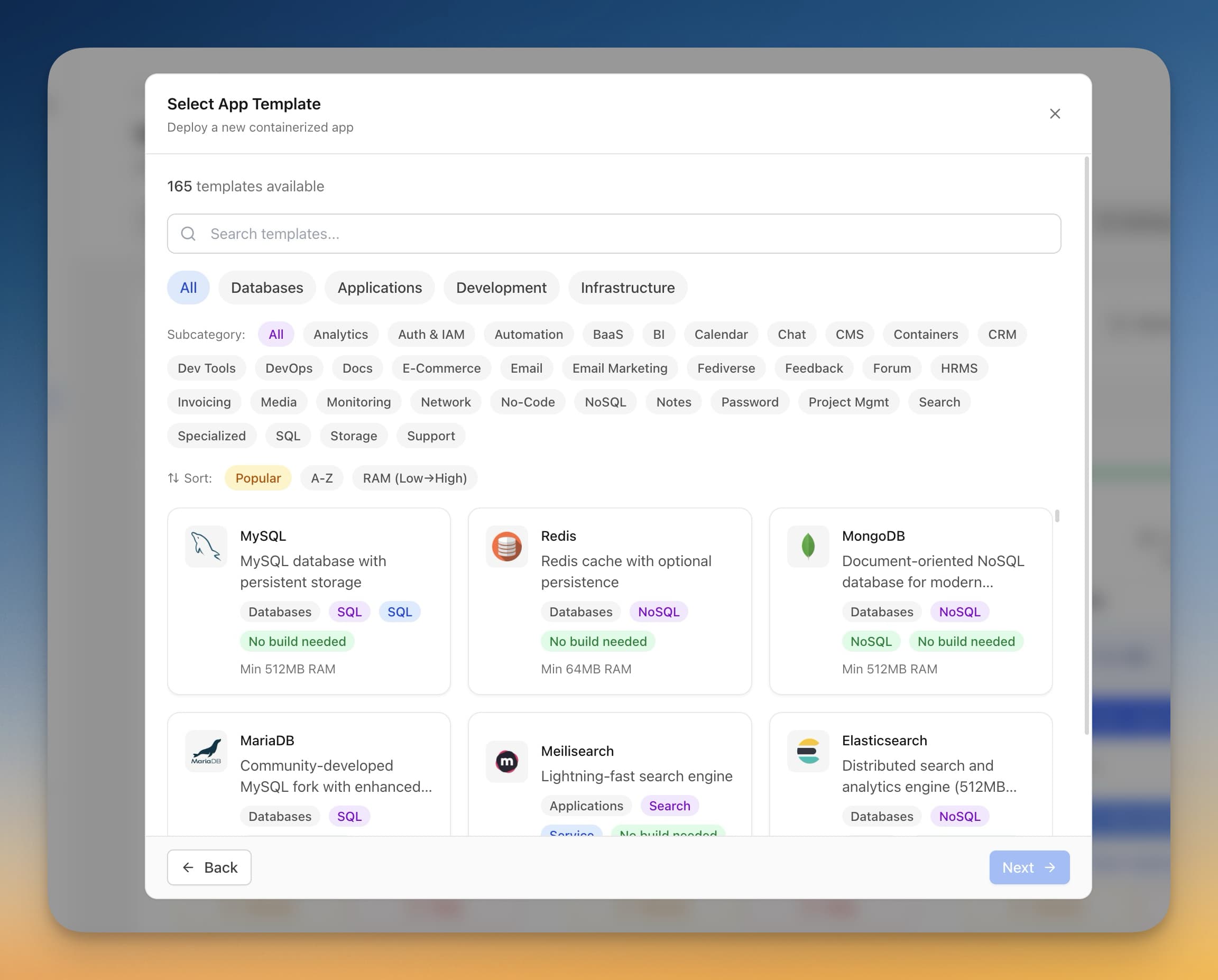
With Server Compass, every app on this list has a one-click deploy template. You pick the app from the template gallery, click Deploy, and Server Compass handles the Docker Compose file, environment variables, port mappings, reverse proxy configuration, and SSL certificates automatically. No terminal required.
Here is what the workflow looks like:
- Connect your VPS to Server Compass (any provider: Hetzner, DigitalOcean, Linode, Vultr, or your own hardware).
- Open the Stack Wizard and search for the app you want.
- Click Deploy. Server Compass generates the Docker Compose stack, configures persistent volumes, and sets up Traefik for automatic HTTPS.
- Point your domain. Server Compass provisions a Let's Encrypt certificate within seconds.
That is it. No YAML editing, no SSH sessions, no debugging port conflicts.
Choosing the Right VPS for Self-Hosting
Most of the apps on this list run comfortably on a $5-10/month VPS. A server with 2 GB RAM and 40 GB SSD can handle 5-8 lightweight apps (Uptime Kuma, Umami, Vaultwarden, Gitea, Listmonk, NocoDB, Meilisearch, and MinIO all fit). For heavier apps like Supabase, Immich, or Nextcloud, step up to 4 GB RAM.
The math almost always works out in your favor. A typical SaaS stack of analytics + email marketing + password management + project management could cost $50-100/month in subscriptions. The same tools self-hosted on a $10 VPS cost you just that $10.
Start Building Your Self-Hosted Stack
The best self-hosted apps are the ones you actually use. Start with one or two that solve an immediate problem — maybe Uptime Kuma to monitor your sites, or Plausible to replace Google Analytics. Once you see how easy it is, you will keep adding more.
Server Compass ships with 247+ one-click templates covering all 20 apps on this list and hundreds more. Browse the full template gallery or download Server Compass to start deploying.
Related in the StoicSoft network
If you're self-hosting on a VPS or working through a deployment guide like the one above, DeployToVPS is the StoicSoft network's handbook for VPS deployment recipes — docker-compose, nginx, traefik, and common app self-hosts.
From across the StoicSoft network
Hand-curated reads on the same topic from sister sites in the StoicSoft family.